
Jane and Jean: Two Women, One Choice, Very Different Futures
Meet Jane and Jean. They are both 52, live in the same suburb, and on paper their lives look remarkably similar. Same age, same stage, kids mostly grown, busy jobs, mortgages winding down.
But look a little closer at their daily habits and you will see two very different futures quietly taking shape. Not dramatically. Not overnight. Just one small choice at a time, compounding year after year, exactly like interest in a bank account.
So let’s do something we rarely get to do in real life. Let’s fast forward through the next three decades and watch what happens.
Today, at 52
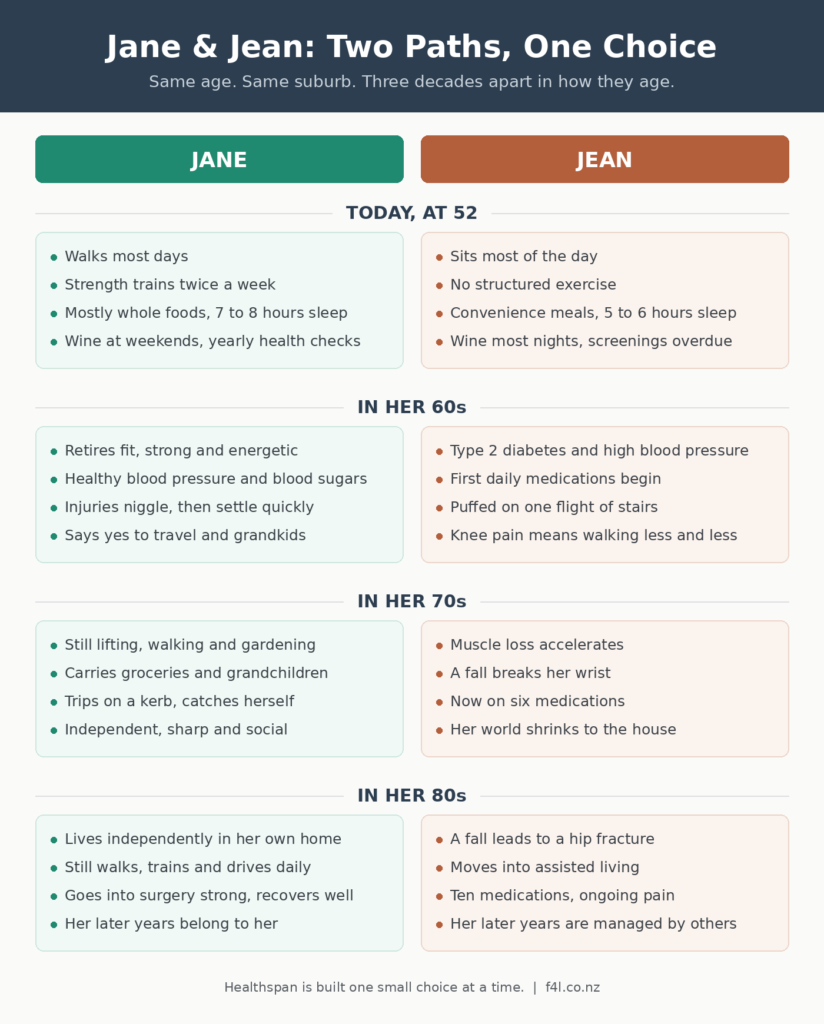
Jane walks most mornings, lifts weights twice a week, and cooks mostly whole foods. She sleeps around seven to eight hours, keeps wine to the weekend, books her health checks every year, and runs with a local group on Saturdays. Life is still busy and stressful at times, but movement and time outdoors are how she resets.
Jean drives to a desk job, sits for most of the day, and relies on convenience meals because she is, in her words, “too tired to cook.” Sleep is five to six broken hours. Wine most evenings takes the edge off. Exercise is something she keeps meaning to get back to, and that screening reminder letter has been on the fridge for two years.
Here is the thing. At 52, Jane and Jean look almost the same. Jean might even be the one telling Jane she is “lucky to have good genes.” But the science of ageing tells us something different: from our 50s onwards, the gap between these two women will not stay small. It widens, decade by decade.
The next 30 years, side by side
This isn’t fortune telling, it’s physiology
Nothing in Jean’s column is bad luck, and nothing in Jane’s column is good genes. Both stories are simply the long term maths of a few key processes:
Muscle. From around age 50, we lose muscle at an accelerating rate unless we actively train to keep it. In plain terms: muscle is the currency of independence. It is what gets you off the toilet, up the stairs and back off the floor at 85. Jane has been making deposits for 30 years. Jean has been making withdrawals.
Bone. Strength work and impact loading keep bones dense. Dense bones bend the odds when a fall happens, and falls are one of the biggest turning points in older age. The wrist fracture in Jean’s 70s and the hip fracture in her 80s are statistically two of the most common, and most life altering, injuries for older women.
Metabolic health. Daily movement, decent sleep, mostly whole foods and moderate alcohol keep blood sugar and blood pressure in check. Skip those, and conditions like type 2 diabetes arrive quietly in the 60s, bringing a lifetime of medication with them.
Connection. This one surprises people. Staying mobile is what keeps us social, and staying social is one of the strongest predictors of healthy ageing we have. When Jean’s mobility shrinks, her world shrinks with it.
The technical term for what separates these two women is healthspan: not how long you live, but how many of those years you spend healthy, capable and independent. Jane and Jean may well live to a similar age. They will not live the same life.
The most important part of this story
Here is what matters most, and it is good news.
If you read Jean’s column and felt a flicker of recognition, her story is not locked in. The research on this is genuinely encouraging: people who start strength training in their 60s, 70s and even 90s still build muscle, improve balance and reduce their falls risk. The body responds at every age. Late is dramatically better than never.
And if you are in your 40s or 50s right now? You are standing at exactly the fork in the road where Jane and Jean’s paths split. The decisions feel small today. A walk. Two strength sessions a week. A proper bedtime. Vegetables on the plate. A booked health check.
None of it is glamorous. All of it compounds.
So, the only question that really matters: whose column are you currently writing?