
Most people train to look better, move better, or feel better physically. Fair enough. But there’s another reason to push yourself that rarely makes it onto a fitness goal list, and it might be the most compelling one of all.
When you work hard, your brain gets stronger. Not metaphorically. Literally.
Here’s the link, and why it matters for your performance, focus, and long-term health.
The molecule you’ve probably heard of but misunderstood
You’ve felt lactate before. It’s the burn that builds in your legs on a hard run, the sensation in your lungs at the top of a steep hill, the heavy feeling in your muscles near the end of a set. For a long time, lactate was labelled a waste product, something your body produces and needs to clear. That story has been rewritten.
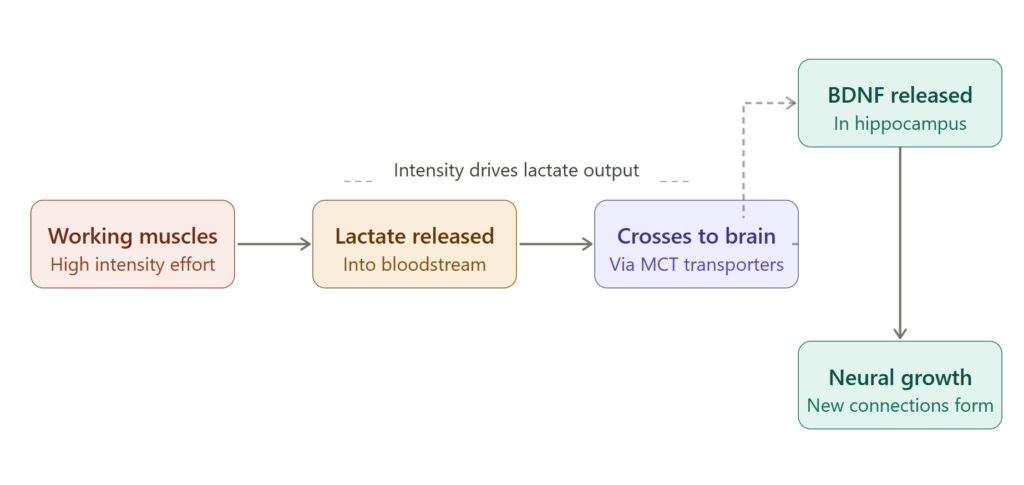
We now know lactate is a signalling molecule. When your muscles produce it during intense effort, it enters your bloodstream and travels to your brain, where it crosses the blood-brain barrier and triggers a cascade that ends with the production of something called BDNF.
A quick science flag: what is BDNF?
This is where it gets a little technical, but stick with it for a moment because the payoff is worth it.
BDNF stands for Brain-Derived Neurotrophic Factor. Think of it as fertiliser for your brain cells. It promotes the growth of new neurons, strengthens existing connections between brain cells, and supports the repair of neural pathways. The areas of the brain most responsive to BDNF, particularly the hippocampus, are the same areas responsible for memory, learning, decision-making, and emotional regulation.
In short: more BDNF equals a more capable, more resilient brain.
The simplified pathway looks like this. You exercise hard → your muscles produce lactate → lactate crosses into the brain → a molecular chain reaction triggers BDNF production → your brain grows new cells and connections.
The harder the effort, the more lactate you produce. The more lactate, the stronger the BDNF signal.
What types of exercise create this environment?
Not all exercise drives this equally. The key variable is intensity. Here’s what the research points toward, roughly in order of effectiveness.
High-intensity interval training (HIIT) sits at the top of the list. Short, hard bursts followed by recovery periods spike lactate repeatedly across a session, giving your brain multiple signals. This works across modalities, whether that’s running, cycling, rowing, or circuit training.
Threshold or tempo training, where you sustain effort at or just above your lactate threshold for 20 to 30 minutes, keeps your body in the productive zone for longer. Less dramatic than HIIT, but highly effective for sustained BDNF stimulation.
Uphill and incline training is worth calling out specifically. Research on prolonged uphill exercise found meaningful increases in BDNF in the areas of the brain associated with memory and learning. This matters practically for anyone whose joints don’t love high-speed running. A steep walk or hike can produce a similar lactate response at far lower impact.
Resistance training at moderate to high loads also contributes. The mechanism is slightly different, involving muscle tissue releasing precursors to BDNF directly, but the outcome is comparable.
For most people, a practical structure looks like this: two higher-intensity sessions per week, either HIIT or tempo, supported by two or three aerobic base sessions at a moderate pace. That combination maintains the conditions for regular BDNF production without burning out the body.
What does sustained BDNF actually do for you?
This is where the performance and cognitive edge comes in.
Memory and learning sharpen. BDNF supports the formation of new synaptic connections and long-term potentiation, which is the brain’s process for encoding information more durably. If you’re someone who needs to absorb and apply new skills, strategies, or information, a brain running high BDNF is running a better operating system.
Mood and mental clarity improve. Lower BDNF levels are associated with depression and anxiety. Regular exercise that keeps BDNF elevated works as a genuine mood regulator, not just a stress release valve but a direct neurological intervention.
Cognitive decline slows. Research suggests that higher BDNF levels are associated with a reduced risk of neurodegenerative conditions, including Alzheimer’s. Aerobic exercise has been shown to increase hippocampal volume, the part of the brain most vulnerable to age-related shrinkage, by around two percent.
Fatigue and pain tolerance improve. Studies consistently link exercise-induced BDNF increases with reductions in perceived fatigue and pain, alongside improvements in physical and cognitive function.
The practical takeaway
Easy movement has value. A daily walk, a light swim, a recovery ride, all of these contribute to your overall health. But if cognitive performance, mood resilience, and long-term brain health are goals, then intensity is not optional. The lactate burn you feel during a hard effort is the signal your brain is waiting for.
Getting uncomfortable a few times a week is not just a physical strategy. It’s a cognitive one.