
Protein Does Not Become Muscle Just Because You Ate It
In the last post we broke down what your metabolism actually is, and where protein fits into the energy side of that equation. This one goes a step further, into what happens to that protein once it is inside you.
Here is the part most people skip past. Eating protein does not automatically build muscle. After a meal, amino acids arrive in your bloodstream, and your muscle has to accept them and build them into contractile tissue. That handover is the step that decides whether the protein on your plate becomes part of you or simply passes through, and it is not guaranteed. It responds to what your muscles have actually been doing.
The Clearest Proof Runs in the Negative
Some of the best evidence for this comes from watching what happens when people move less.
Researchers at McMaster University took ten healthy older adults, average age 72, and cut their daily step count by roughly three quarters, down to around 1,400 steps a day, for two weeks. Nothing else about their diet or protein intake changed.
The results were striking. The muscle building response to a meal fell by around 26 percent. Their fasted rate of protein synthesis, the baseline turnover that happens regardless of eating, was unchanged. It was specifically the after meal response that dropped. Leg lean mass fell by almost 4 percent in a fortnight, insulin sensitivity worsened by over 40 percent after eating, and inflammatory markers rose as well.
Two weeks of moving less, and the exact same meal did less for these people’s muscles.
Then Someone Ran It Forwards
A research group at the University of Toronto flipped the question. Instead of asking what happens when you sit still for two weeks, they asked what happens if you interrupt sitting, even briefly, on a single day.
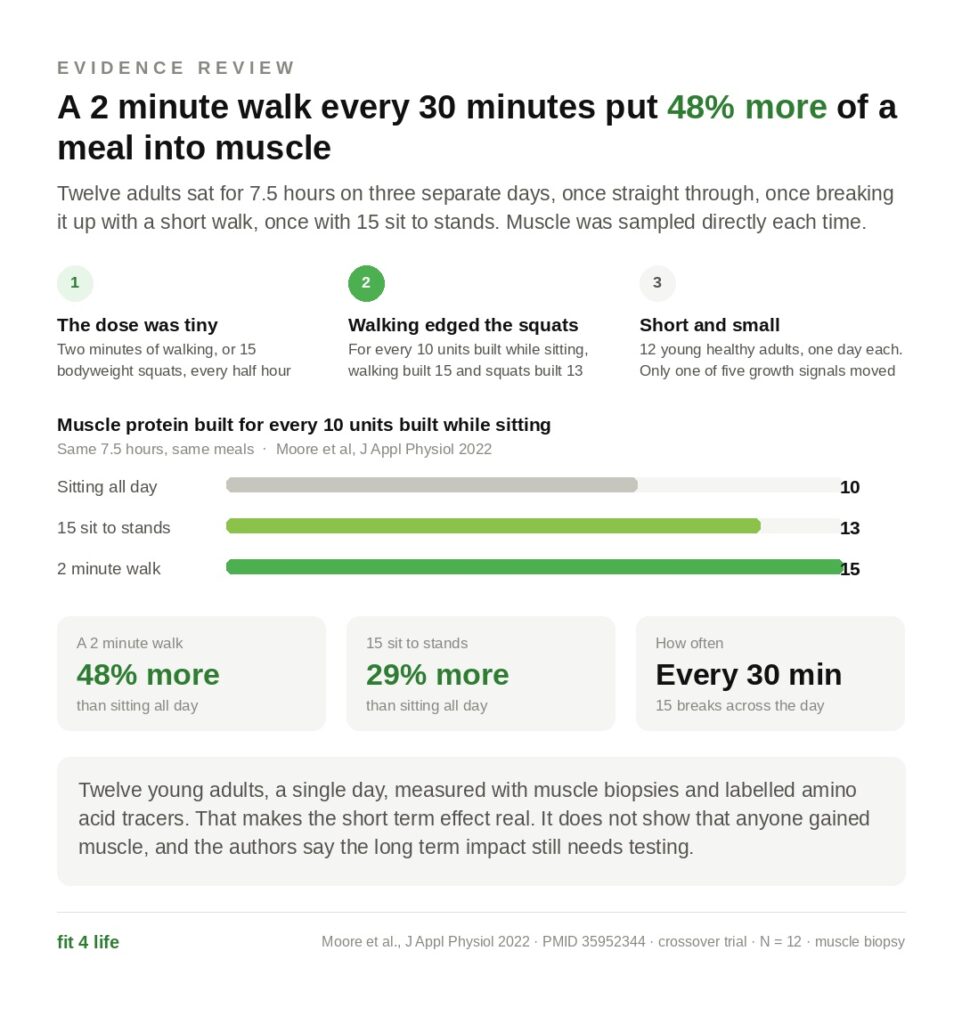
Twelve healthy adults sat for seven and a half hours on three separate occasions, eating identical meals labelled with tracers so the researchers could follow exactly where the amino acids ended up. On one day, they sat the whole time. On the other two, every thirty minutes they either walked for two minutes or stood up and did fifteen bodyweight squats. Muscle tissue was biopsied directly to measure the result.
For every ten units of muscle protein built on the sitting day, the group who stood up and squatted built thirteen, and the group who walked built fifteen.
Two minutes of walking, repeated fifteen times across the day, was enough to measurably shift how much of that meal’s protein ended up as muscle tissue rather than being used elsewhere.
Interestingly, of five separate growth signalling proteins the researchers measured inside the muscle, only one moved at all, and only in the squat group. The other four were unchanged. So the effect on actual muscle protein built is real and measured directly, but the full biological pathway behind it is still not completely mapped.
What This Is, and What It Is Not
Worth being clear about the limits here, because good evidence deserves an honest read.
The Toronto study involved twelve young, healthy adults, on a single day, with careful direct measurement. It is not evidence that anyone in the study gained muscle, and the researchers themselves say the long term impact still needs testing. What it shows is that the building block level response to a meal can be shifted by brief, simple movement, within hours.
Taken together though, the direction from both studies lines up. Sitting still for extended periods makes a meal count for less. Standing up and moving, even briefly, makes it count for more.
What This Means for You
You do not need a formal training session to influence this. The evidence suggests that breaking up long sitting blocks with short bursts of movement, a two minute walk, a set of bodyweight squats, standing up from your desk, genuinely changes how your body handles the protein in your next meal.
This is not a replacement for structured resistance training, which remains the strongest lever you have over muscle mass and metabolic rate long term, as we covered in the last post. But it is a reminder that the hours between your workouts are not neutral. What you do with them appears to matter more than most people realise.
Sources Breen L, Stokes KA, Churchward-Venne TA, et al. Two weeks of reduced activity decreases leg lean mass and induces “anabolic resistance” of myofibrillar protein synthesis in healthy elderly. J Clin Endocrinol Metab. 2013. PMID 23589526.
Moore DR, Williamson EP, Hodson N, et al. Walking or body weight squat “activity snacks” increase dietary amino acid utilization for myofibrillar protein synthesis during prolonged sitting. J Appl Physiol. 2022. PMID 35952344.
Is coaching right for me? Find out here